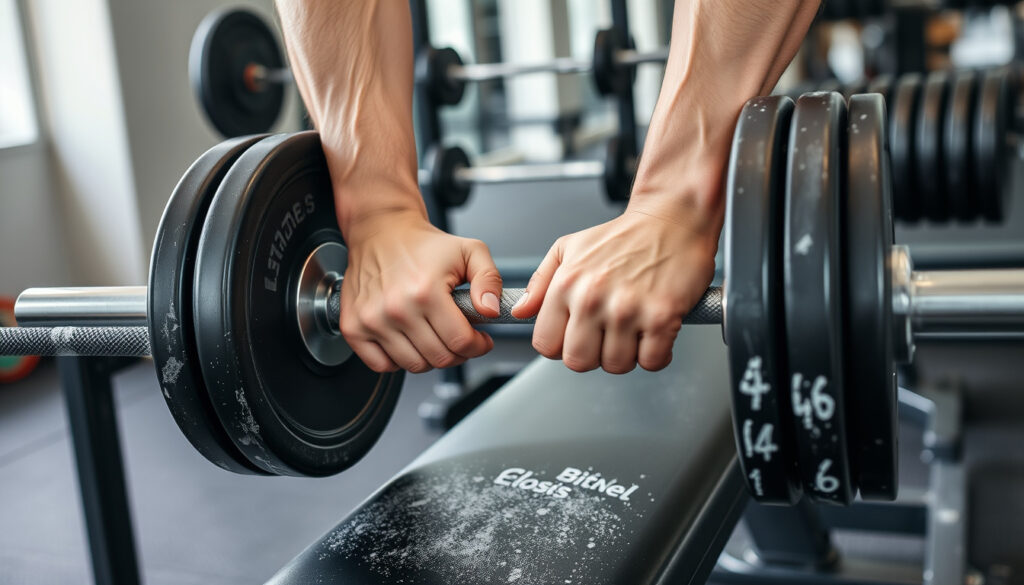
Close Grip Bench Press: Muscles Worked, Form, Benefits & Alternatives
Anyone who’s ever chased arm growth knows the triceps make up roughly two-thirds of the upper arm. The close-grip bench press is one of the most direct ways to load them with a heavy compound movement, but nailing the form and understanding exactly what it does — and doesn’t do — separates a great triceps builder from a shoulder-wrecking squat rack habit. Here’s the research-backed breakdown of how to execute it, what it hits, and whether it wins the war against skull crushers.
Primary muscles worked: triceps brachii, pectoralis major (upper chest), anterior deltoids · Grip width: approximately shoulder-width or narrower, typically 12-18 inches apart · Movement pattern: multi-joint horizontal press with elbows tucked · Common equipment: barbell, dumbbell, EZ bar, or machine · Difficulty vs standard bench press: requires ~10-20% less weight due to reduced chest/lever advantage
Quick snapshot
- Triceps activation is 30-40% higher in close-grip vs standard bench (ATHLEAN-X).
- It works the chest and shoulders as secondary movers (Muscle & Strength).
- Close-grip bench press is a compound movement (T-Nation).
- Optimal grip width for peak triceps activation varies individually based on arm length.
- Whether the exercise is superior to skull crushers for overall triceps hypertrophy is debated.
- Decades of use in powerlifting and bodybuilding for triceps mass and lockout strength.
- Growing interest from home-gym lifters using dumbbells and EZ bars.
- Expect more direct research comparing the triceps head activation between close-grip bench and skull crushers.
- Dumbbell and machine versions will likely continue to grow in popularity for their reduced shoulder stress.
The numbers behind the movement clarify why this variation earns its reputation in a crowded field of triceps builders.
| Metric | Value |
|---|---|
| Primary action | Elbow extension with shoulder horizontal adduction |
| Triceps activation (EMG) | Approximately 30-40% higher than standard bench press |
| Standard grip width | 12-18 inches apart |
| Incline variant | Upper chest and triceps emphasis when done on 30-degree incline |
| Common injuries if done wrong | Wrist strain, shoulder impingement |
What does close grip bench press work?
Triceps activation: 30-40% higher vs standard · Chest involvement: Secondary stabilizer · Shoulder stress: Reduced if elbows tucked
Muscles targeted by close grip bench press
Primary mover: Triceps brachii · Secondary: Upper pectoralis major, anterior deltoid · Stabilizers: Lats, rear delts, core
The movement changes the lever arm enough that the triceps become the dominant driver. According to ATHLEAN-X (physical therapy and strength coaching), the close-grip bench press primarily targets the triceps brachii and also recruits the pectoralis major and anterior deltoids. A tutorial from Muscle & Strength (exercise database and community) adds that the chest and shoulders are secondary stabilizers that assist the pressing motion.
Triceps brachii: lateral, medial, and long heads
Lateral head: Powerful lockout · Medial head: Deep stability · Long head: Assisted by stretch
All three heads of the triceps are active during the press, but the medial head is preferentially recruited due to the full elbow extension mechanics required at the top of the movement. A YouTube tutorial on form notes that fully locking out the elbows at the top forces a peak contraction of the triceps, maximizing recruitment across the entire muscle group.
Upper chest and anterior deltoid involvement
- Upper chest: Primary synergist when the bar touches the lower sternum area, providing horizontal adduction force.
- Anterior deltoids: Assist in the first phase of the press off the chest, especially when the elbows stay tucked.
- Biomechanical role: They act as stabilizers, allowing the triceps to focus on extension without losing shoulder integrity.
The implication: If your goal is pure triceps overload, this variation offers a rare compound movement that directly challenges all three heads while maintaining pressing strength.
Is close grip bench harder? How much harder is a close grip bench?
Standard bench (70 kg lifter): 100 kg intermediate · Close grip equivalent: ~80-85 kg
Strength comparison: close grip vs standard bench press
Load difference: 10-20% reduction for close grip · Primary limiter: Triceps strength, not chest strength
Yes, it is harder in the sense that you will lift about 10-20% less weight. REP Fitness (training blog) describes the close-grip as having a heavier-load potential than triceps isolation movements but significantly lighter than a standard bench press. The narrower grip shortens the chest’s lever arm, forcing the smaller triceps muscle group to carry the majority of the load.
Why close grip bench press requires less weight
- Leverage change: The shortened moment arm at the shoulder reduces chest peak torque.
- Muscle recruitment shift: The triceps become the primary driver because the elbow extension moment arm remains long.
- Mechanical disadvantage: The chest cannot generate as much horizontal adduction force with the arms tucked.
Estimated load reduction for close grip bench press
Most lifters find their worksets drop by about 15% when switching from a standard to a close grip. A 225-lb bench presser might load 190-200 lbs for close-grip sets. The reduction varies individually based on limb length, triceps strength, and grip width.
The catch: less weight doesn’t mean less work. The triceps are smaller muscles, so the relative effort is often higher than a standard bench press at the same percentage of your max.
Which is better, skull crushers or close grip bench press?
CGBP activation: Compound, all heads · Skull crusher activation: Isolation, long head bias
Close grip bench press vs skull crushers: muscle activation
Skull crushers are an isolation movement, targeting the triceps without significant chest or shoulder involvement. Mirafit (fitness equipment guide) states that skull crushers primarily target the triceps brachii, which has three heads. In contrast, the close-grip bench is a compound press that distributes the load across the triceps, chest, and shoulders. A forum discussion on T-Nation (strength training forum and magazine) argues that skull crushers and close-grip bench press are both triceps exercises but differ because skull crushers are isolation movements while close-grip bench press is a compound movement.
Compound vs isolation: which is more effective for triceps growth?
- Compound: Heavier loads, greater systemic stress, more carryover to pressing strength.
- Isolation: Sustained tension on the long head through a deep stretch, a stimulus hard to replicate with a press.
- Synergy: A combination of both often produces the greatest overall triceps growth.
According to a source on Instagram, the close-grip bench press reportedly develops the lateral triceps head more than skull crushers, while skull crushers produced greater hypertrophy of the medial and long triceps heads in a 10-week training comparison. A coach from Outlift (hypertrophy-focused publication) argues that while the close-grip bench press is excellent for building the lateral head with heavy weights, skull crushers allow you to bias the long head through a deep stretch.
Exercise selection by goal: strength vs hypertrophy
- Strength goal: Close-grip bench press wins for its ability to load the triceps with heavy weight and improve lockout strength.
- Hypertrophy goal: Both are effective. Skull crushers provide a unique stretch stimulus, while the close-grip bench allows for progressive overload.
- Recommendation: Use the close-grip bench as your primary heavy triceps movement and skull crushers as a secondary isolation exercise.
Is a close grip bench press worth doing?
Benefits of close grip bench press
- Superior triceps activation compared to standard bench press (ATHLEAN-X).
- Carries over to standard bench press lockout strength.
- Versatile — works with barbell, dumbbell, or EZ bar.
- Requires only a bench and weight — a gym essential.
Potential drawbacks and risks
- Heavier load than isolation movements, increasing shoulder risk if form breaks down.
- Less long-head triceps emphasis compared to overhead extensions or skull crushers.
- Wrist discomfort common if the grip is too narrow or the bar is not properly positioned in the palm.
Who should include close grip bench press in their routine
- Intermediate lifters: Those stuck on bench plateaus can build lockout strength.
- Bodybuilders: Anyone specifically targeting triceps hypertrophy without wanting to give up a pressing pattern.
- Home-gym athletes: It delivers a high triceps stimulus without a cable tower or specialized equipment.
Why this matters: it is not a replacement for the standard bench press, but a complementary variation. Proper form (elbows tucked, controlled descent) reduces shoulder and wrist strain and keeps the focus on the triceps.
How much should a 70 kg man bench press? Is 100 kg good for a 75 kg man?
70 kg man: 70 kg (novice), 100 kg (intermediate) · 75 kg man: 100 kg (intermediate)
Bench press standards by body weight
- Novice: 1x bodyweight — a 70 kg man benching 70 kg is a novice.
- Intermediate: 1.25x to 1.5x bodyweight — a 75 kg man benching 100 kg (1.33x BW) clears the intermediate threshold by most established strength standards.
- Advanced: 1.75x+ bodyweight requires consistent, focused training over years.
What is a good bench press for an intermediate lifter?
- Absolute benchmark: 1.25x bodyweight is the typical gateway to intermediate status.
- Context: A 75 kg man hitting 100 kg is not elite, but it is a solid, respectable number that indicates good training consistency.
- Plateau: Moving from 100 kg to 120 kg often requires specialized programming and attention to weak points.
Standards for close grip bench press? (approximate adjustments)
Close grip adjustment: 10-20% reduction from flat bench · Equivalent for 75 kg intermediate: ~80-85 kg
Because the close-grip variation requires 10-20% less load for the same rep range, an intermediate lifter’s close-grip max would be roughly 80-85% of their standard bench max.
The pattern: Strength standards are a useful compass, not a finish line. The close-grip benchmark runs 10-20% behind, but hitting those numbers signals real triceps strength.
Close Grip Bench Press vs. Skull Crushers: The Differences Row by Row
Seven key dimensions, one clear pattern: the two exercises complement more than they compete.
| Feature | Close Grip Bench Press | Skull Crushers |
|---|---|---|
| Movement Type | Compound (multi-joint) | Isolation (single-joint) |
| Primary Muscles | Triceps, Upper Chest, Anterior Delt | Triceps (long head bias) |
| Load Ability | Heavy (10-20% less than flat bench) | Moderate (limited by elbow stability) |
| Triceps Head Emphasis | Lateral, Medial, Long | Long, Medial |
| Injury Risk | Shoulder, Wrist | Elbow (if uncontrolled) |
| Best For | Pressing strength, mass | Triceps shape, stretch-mediated hypertrophy |
These insights, confirmed by REP Fitness, Outlift, and T-Nation, highlight the complementary nature of the two lifts. If you have to pick just one triceps exercise for a whole training cycle, the close-grip bench press wins because it allows the heaviest loads and has the most carryover to other lifts. But layering in skull crushers is the shortcut to long-head development that a press alone cannot match.
The close-grip bench press forces the triceps to carry a load that isolation moves simply cannot. For the lifter who only has time for one triceps exercise, this compound movement is the highest-return option.
Upsides vs. Downsides of the Close Grip Bench Press
Upsides
- Superior triceps activation compared to standard bench press.
- Builds lockout strength that carries over to the flat bench.
- Versatile — barbell, dumbbell, EZ bar, or machine.
- Teaches elbow tucking mechanics valuable for all pressing.
Downsides
- Heavier load than isolation, increasing shoulder risk if form falters.
- Less long-head bias compared to overhead extensions or skull crushers.
- Wrist discomfort common if the grip is too narrow.
- Not a direct chest builder — do not replace your flat bench with it.
The choice: decide based on your priorities. If pressing strength and heavy progressive overload are your goal, the close-grip bench is superior. If you need targeted long-head development, skull crushers fill the gap.
How to Perform the Close Grip Bench Press with Proper Form
Mastering the setup and execution is the difference between a triceps blaster and a shoulder injury waiting to happen.
- Set the grip. Grip the bar with your index fingers placed on the smooth ring of a standard barbell (approximately shoulder-width apart).
- Set your shoulders. Lie back on the bench, squeeze your shoulder blades together, and plant your feet firmly on the floor.
- Unrack and brace. Unrack the bar and hold it directly above your shoulders. Take a deep breath into your diaphragm.
- Lower with tuck. Lower the bar to your lower chest/sternum, keeping your elbows tucked at roughly a 45-degree angle to your torso. The bar path should be slightly diagonal, ending below the nipple line.
- Drive and lock out. Press the bar back up, driving through your triceps. Fully extend your elbows at the top for a peak contraction, but do not lock out violently.
- Repeat. Maintain tension throughout the set. Avoid bouncing the bar off your chest.
Common mistakes include flaring the elbows (which turns the exercise into a shoulder press) and using a grip so narrow that the wrists bend painfully. ATHLEAN-X emphasizes that the elbows must stay tucked to keep stress off the shoulder joint, much like the mechanics of chest compressions in CPR require stable, controlled downward force. For a lifter tracking macros, pairing this exercise with a precise diet is key; check out our guide on How Long to Grill Chicken Breast for perfectly cooked lean protein.
What We Know vs. What’s Still Unclear
Confirmed facts
- The close-grip bench press activates the triceps more than the standard bench press (ATHLEAN-X).
- It requires 10–20% less weight than a standard bench press for the same rep range (REP Fitness).
- Proper form includes elbows tucked to avoid shoulder stress (ATHLEAN-X).
- It works the upper chest and anterior delts as secondary movers (Muscle & Strength).
What’s still debated or unclear
- The optimal grip width for maximizing triceps activation varies individually based on arm length and strength balance.
- Whether the close-grip bench press is superior to skull crushers for overall triceps hypertrophy is likely individual-dependent. An Instagram post claiming specific head-specific hypertrophy advantages hasn’t been replicated in peer-reviewed research.
- The exact breakdown of activation across the three triceps heads in a single session is difficult to measure without invasive EMG protocols.
- Whether the 30-40% activation increase cited by ATHLEAN-X translates exactly to proportional hypertrophy gains is not directly proven by longitudinal research.
What the Experts Say
“The closer the grip, the more you take the chest out of the equation and place the load squarely on the triceps. It’s a simple lever change.”
— Jeff Cavaliere, physical therapist and founder of ATHLEAN-X
“While the close-grip bench press is excellent for building the lateral head with heavy weights, skull crushers allow you to bias the long head through a deep stretch, a stimulus that is hard to replicate with a press.”
— Coach at Outlift (hypertrophy-focused publication)
“Skull crushers and close-grip bench press are both triceps exercises, but they differ because skull crushers are isolation movements while close-grip bench press is a compound movement.”
— T-Nation (strength training forum and magazine)
Strength standards are a compass, not a finish line. The close-grip variation runs about 10-20% behind your flat bench numbers, but mastering it signals a level of triceps strength that isolation alone can’t build.
For the lifter serious about triceps development, the close-grip bench press is a non-negotiable tool in the arsenal. It delivers a compound stimulus that isolation alone cannot match. But the choice isn’t either/or: layering in skull crushers or other isolation work is likely the shortest path to balanced triceps growth. For the home gym enthusiast with a barbell and a pair of dumbbells, mastering this variation means unlocking triceps gains without needing a cable tower or a dozen attachments. The call is clear: keep the bench press in your routine, but narrow the grip and lock out every rep. Lifters who prioritize recovery know that protein timing matters; our guide on grilling chicken breast helps nail the lean protein prep, and mastering this variation is similar to how mastering CPR requires precise, repetitive technique.
instagram.com, learn.athleanx.com, repfitness.com, outlift.com, instagram.com, muscularstrength.com, mirafit.co.uk, gettfit.com, youtube.com
Frequently asked questions
Is close grip bench press good for chest growth?
It primarily hits the triceps, but the upper chest and anterior delts act as synergists. It’s not a primary chest builder, but it contributes to overall upper body pressing mass.
Does close grip bench press build bigger triceps?
Yes. The heavy compound loading directly drives triceps hypertrophy, especially when paired with adequate volume and progressive overload.
What is the ideal rep range for close grip bench press?
For hypertrophy, 6-12 reps per set. For strength and lockout power, 3-5 reps per set with heavier loads.
Can I do close grip bench press every day?
No. The triceps are a smaller muscle group and need 48-72 hours of recovery between intense sessions to avoid overtraining and injury.
Should close grip bench press replace my flat bench press?
No, it is a complementary exercise, not a replacement. The standard bench press is superior for chest development and overall pressing strength.
Does close grip bench press work the long head of the triceps?
All three heads of the triceps are active, but the medial head is preferentially recruited by full elbow extension. The long head gets more work in exercises that emphasize a stretch, like skull crushers or overhead extensions.
What are common mistakes with close grip bench press?
Flaring the elbows, using a grip so narrow it stresses the wrists, and bouncing the bar off the chest instead of controlling the descent.
More related posts
 The Prince of Egypt: Bible Accuracy, Age Rating & Bans Explained
 SNAP Benefits Government Shutdown: 2025 Impact & Rulings
 Best Coffee Shops Near Me in Dublin – Open Now & Rated (2025)
 Recargar Monedas en TikTok Gratis – Real Options and Risks
 Iowa Hawkeyes Women’s Basketball Schedule – 2024-25 Full Results and Tickets
 Side effects of rosuvastatin: Common, long-term, what to avoid
 HVAC Service Near Me: Signs, Frequency & Ireland Tips
 Did Taylor Swift and Travis Kelce Break Up? No, Engaged