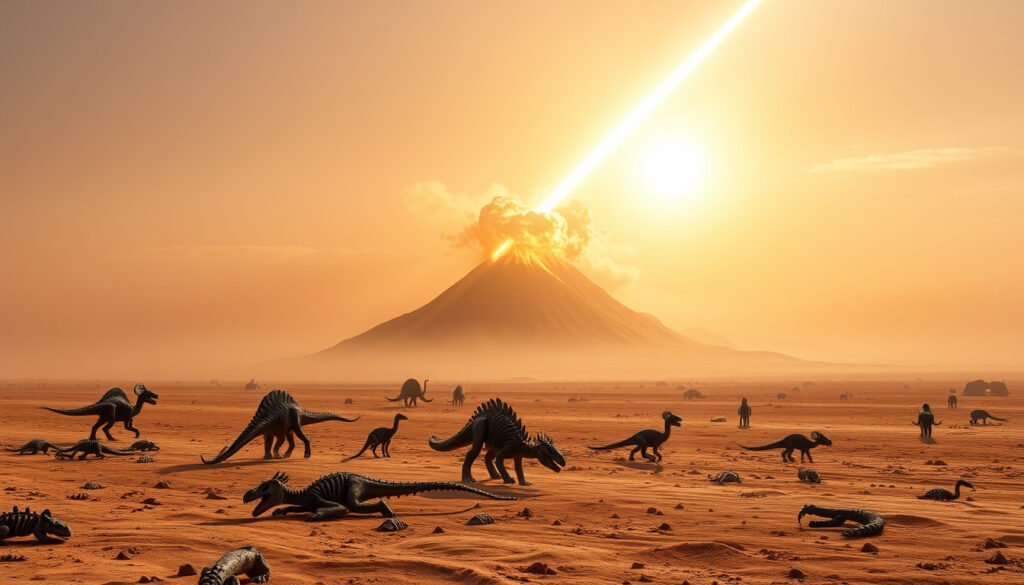
When Did Dinosaurs Go Extinct? The 66-Million-Year Answer
If you ask someone when dinosaurs went extinct, you might get two different answers: 65 million years ago or 66 million years ago. That one-million-year gap isn’t a rounding error — it’s a story about how science gets better at telling time.
Extinction event date: 66 million years ago (end of Cretaceous Period) ·
Primary cause: Asteroid impact (Chicxulub crater, Yucatán Peninsula) ·
Non-avian dinosaurs wiped out: All except birds ·
Duration of dinosaur reign: Approximately 165 million years ·
Surviving dinosaur lineage: Birds (avian dinosaurs)
Quick snapshot
- Non-avian dinosaurs went extinct ~66 million years ago (Lunar and Planetary Institute (planetary science research center))
- The extinction is linked to the Chicxulub impact (NASA Science (U.S. space agency))
- Birds are the only dinosaurs alive today (Lunar and Planetary Institute) (Lunar and Planetary Institute (planetary science research center))
- The 65-million-year figure is outdated (National Science Foundation (U.S. government science agency))
- Precise timeline of extinction (days vs years) is still debated (PNAS (peer-reviewed scientific journal))
- Exactly how many dinosaur species were alive at the moment of impact (PubMed Central / NIH (U.S. National Institutes of Health))
- The role of Deccan Traps volcanism as a contributing factor (PNAS) (PNAS (peer-reviewed scientific journal))
- 66 million years ago: Chicxulub impact (Lunar and Planetary Institute) (Britannica (encyclopedia publisher))
- End of Cretaceous Period (Britannica (encyclopedia publisher))
- Wiped out 75% of species (PubMed Central / NIH) (Britannica (encyclopedia publisher))
- Birds survived as the only dinosaur lineage (Lunar and Planetary Institute) (Britannica (encyclopedia publisher))
- Refined dating pushes extinction date from 65 to 66 million years ago (National Science Foundation) (USGS (U.S. Geological Survey))
- Debate continues on volcanism vs impact (PNAS) (USGS (U.S. Geological Survey))
- New fossil discoveries may clarify extinction timeline (USGS (U.S. Geological Survey))
Six key facts, one pattern: the science has converged on a precise date, but the public conversation still lags behind.
| Fact | Value |
|---|---|
| Extinction date (current consensus) | 66 million years ago |
| Previous estimate | 65 million years ago |
| Primary cause | Asteroid impact (Chicxulub) |
| Non-avian dinosaurs lost | All species |
| Surviving dinosaur lineage | Birds (approximately 10,000 species today) |
| Duration before extinction | About 165 million years |
When did dinosaurs go extinct — and how do we know?
The K-Pg boundary and radiometric dating
- The Cretaceous–Paleogene (K–Pg) boundary marks the end of the Cretaceous Period and the beginning of the Paleogene Period (Lunar and Planetary Institute).
- The Chicxulub impact occurred about 66 million years ago (Lunar and Planetary Institute).
- NASA describes the asteroid impact as having triggered the mass extinction that ended the dinosaurs (NASA Science).
- The K–Pg boundary is a geologic time marker, not just a biological extinction label (USGS).
Scientists date the boundary using radiometric techniques — measuring the decay of radioactive isotopes in rocks. The K–Pg boundary is found worldwide as a thin layer of iridium-rich clay, a fingerprint of the asteroid impact. Boundary sections in Mississippi preserve a spherule-rich bed linked to the K–Pg event (USGS).
Why the date shifted from 65 to 66 million years
- Earlier estimates placed the date at about 65 million years ago (National Science Foundation).
- Updated techniques (e.g., argon-argon dating) established 66 million years as the widely accepted figure (Lunar and Planetary Institute).
- The shift is mentioned in online discussions (e.g., Reddit) and reflected in authoritative sources (National Science Foundation).
The implication: older textbooks and museum exhibits that say “65 million years” aren’t wrong — they’re just using the best data available at the time. The refinement to 66 million years came from better argon-argon dating of impact melt rocks at the Chicxulub crater, which gave a more precise age.
Did dinosaurs go extinct 65 or 66 million years ago?
Why older sources say 65 million
- Some older sources and public-facing summaries still say 65 million years ago, reflecting outdated rounding rather than the current consensus (National Science Foundation).
- The K–Pg boundary is also historically referred to as the K–T boundary in older literature (Britannica).
Before the 2000s, the best available dating methods placed the extinction at roughly 65 million years. The K–T (Cretaceous–Tertiary) boundary was the old name, replaced by K–Pg when the Tertiary Period was reclassified.
How the 66-million-year figure became standard
- The end-Cretaceous mass extinction occurred around 66 million years ago rather than 65 million years ago (Lunar and Planetary Institute).
- The Chicxulub impact produced a global stratigraphic layer used to identify the boundary (Crater Explorer (geology reference site)).
The catch: if you search online today, you’ll still find plenty of sources saying 65 million years. That’s because many websites, videos, and even some textbooks haven’t updated their numbers. The scientific consensus, however, is clear: 66 million years.
Why did dinosaurs go extinct but not crocodiles, birds, or other animals?
Survival of avian dinosaurs (birds)
- Birds are the only dinosaur lineage that survived (avian dinosaurs) (Lunar and Planetary Institute).
- Non-avian dinosaurs could not adapt to the post-impact conditions (darkness, cold, food chain collapse) (PubMed Central / NIH).
Birds — theropod dinosaurs with feathers — survived because they were small, could fly, and had flexible diets. They are the living descendants of dinosaurs, with approximately 10,000 species today.
Resilience of crocodilians and other groups
- Smaller body size, dietary flexibility, and habitat helped some groups like crocodilians survive (PubMed Central / NIH).
- Mammals survived partly because they were small, burrowing, and omnivorous (PNAS).
The pattern: survival wasn’t about being “tough” — it was about being small, adaptable, and able to wait out the post-impact winter. Crocodilians, turtles, and some fish survived because they lived in water, which buffered temperature swings. Mammals, then tiny shrew-like creatures, burrowed and ate insects and seeds.
Non-avian dinosaurs were the dominant land animals for 165 million years. But their size and specialization — the very traits that made them successful — became liabilities when the asteroid hit. Small generalists inherited the Earth.
The implication: the very adaptations that allowed dinosaurs to rule for so long sealed their fate when the environment changed catastrophically.
What did people call dinosaurs before 1841?
Fossil discoveries before the term ‘dinosaur’
- Before 1841, large prehistoric reptiles were referred to as ‘dragons’, ‘giant lizards’, or given individual names like ‘Megalosaurus’ (Britannica).
- Fossil finds (e.g., Megalosaurus, Iguanodon) were known but not grouped under a single term (Britannica).
When people dug up giant bones in the 17th and 18th centuries, they assumed they belonged to biblical giants, dragons, or mythical beasts. The word “dinosaur” simply didn’t exist.
Richard Owen and the coining of Dinosauria
- Richard Owen introduced the term ‘Dinosauria’ in 1841 (derived from Greek for ‘terrible lizard’) (Britannica).
Owen, a British anatomist, noticed that Megalosaurus, Iguanodon, and Hylaeosaurus shared distinct skeletal features — upright posture, five vertebrae fused to the pelvis — and grouped them under Dinosauria. The name stuck.
The Bible was written thousands of years before Owen coined “dinosaur.” So when people ask why dinosaurs aren’t mentioned in scripture, the answer is partly linguistic: the word didn’t exist. The creatures themselves — as fossils — were unknown to biblical authors.
What this means: the absence of the word “dinosaur” in ancient texts is a linguistic gap, not a historical one.
Why aren’t dinosaurs in the Bible? — Biblical perspectives
Did Adam and Eve live with dinosaurs?
- The Bible does not mention dinosaurs by name because the word did not exist until 1841 (Britannica).
- Most mainstream Christian and Jewish denominations accept that the Bible is not a scientific text; dinosaurs existed long before humans according to scientific consensus (USGS).
Geological and fossil evidence places non-avian dinosaurs 66 million years in the past. Humans, by contrast, appeared only about 300,000 years ago. The gap is 65.7 million years — no overlap.
Why didn’t Jesus mention dinosaurs?
- Some interpret biblical ‘behemoth’ or ‘leviathan’ as possibly referring to large creatures, but this is speculative (Britannica).
- Young Earth creationists sometimes argue for human-dinosaur coexistence, but this conflicts with geological and fossil evidence (USGS).
The catch: the Bible describes “behemoth” (Job 40) and “leviathan” (Job 41) as powerful creatures, but scholars generally interpret these as symbolic or referring to known animals like the hippopotamus or crocodile. No biblical text describes a creature that matches dinosaur anatomy.
When does the Bible timeline place dinosaurs?
- The Bible does not provide a timeline for dinosaurs because the concept didn’t exist when it was written (Britannica).
For readers who take the Bible as literal history, the absence of dinosaurs creates tension. But for the majority of Christians and Jews worldwide, the Bible is understood as a theological document, not a geology textbook. The scientific and spiritual accounts address different questions.
Timeline: Key moments in dinosaur history
- 230 million years ago: First dinosaurs appear (Lunar and Planetary Institute)
- 66 million years ago (end Cretaceous): Asteroid impact, mass extinction of non-avian dinosaurs (Lunar and Planetary Institute)
- 1841: Richard Owen coins the term ‘Dinosauria’ (Britannica)
- 1980s: Widespread acceptance of asteroid impact theory (NASA Science)
- 2000s–2010s: Refined dating pushes extinction date from 65 to 66 million years ago (National Science Foundation)
The pattern: each advance in dating and technology sharpened the timeline, moving from broad estimates to a precise year.
Confirmed facts vs what’s still unclear
Confirmed facts
- Non-avian dinosaurs went extinct ~66 million years ago (Lunar and Planetary Institute)
- The extinction is linked to the Chicxulub impact (NASA Science)
- Birds are the only dinosaurs alive today (Lunar and Planetary Institute)
- The 65-million-year figure is outdated (National Science Foundation)
What’s still unclear
- Precise timeline of extinction (days vs years) is still debated (PNAS)
- Exactly how many dinosaur species were alive at the moment of impact (PubMed Central / NIH)
- The role of Deccan Traps volcanism as a contributing factor (PNAS)
The implication: while the main story is clear, the finer details remain active research areas.
Expert perspectives
“The Chicxulub impact changed the history of life on Earth by driving ecosystem collapse.”
“The K–Pg extinction coincided with major Deccan Traps volcanism, creating a long-running causation debate.”
“The impact site changed the history of life on Earth by driving ecosystem collapse.”
“NSF characterizes Chicxulub crater research as explaining a global catastrophe and dinosaur extinction.”
— National Science Foundation (U.S. government science agency)
Summary
For anyone who grew up learning “65 million years,” the shift to 66 million can feel like a correction that undermines trust in science. But the opposite is true: it’s evidence that science works. The date got more precise because methods improved, not because the original estimate was a guess. For readers navigating conflicting information online — from creationist claims to outdated textbooks — the choice is clear: trust the consensus built on radiometric dating, impact geology, and fossil evidence, or get stuck in a one-million-year gap that was resolved years ago.
ancientodysseys.com, phoenixrefining.com, en.wikipedia.org, en.wikipedia.org
Frequently asked questions
What is the K-Pg extinction event?
The Cretaceous–Paleogene (K–Pg) extinction event was a mass extinction that occurred about 66 million years ago, wiping out approximately 75% of Earth’s species, including all non-avian dinosaurs. It is marked by a global layer of iridium-rich clay and linked to the Chicxulub asteroid impact (Lunar and Planetary Institute).
Are all dinosaurs extinct?
No. Birds are the direct descendants of theropod dinosaurs and are classified as avian dinosaurs. Approximately 10,000 species of birds are alive today, making them the only surviving dinosaur lineage (Lunar and Planetary Institute).
Did any dinosaurs survive the asteroid?
Only avian dinosaurs (birds) survived the end-Cretaceous extinction. Non-avian dinosaurs — including T. rex, Triceratops, and all other classic dinosaurs — went extinct. Small, feathered theropods that could fly and had flexible diets were the ones that made it through (PubMed Central / NIH).
How long did it take for dinosaurs to go extinct?
The immediate effects of the asteroid impact — wildfires, tsunamis, and a dust cloud that blocked sunlight — occurred within hours to years. However, the full extinction process, including ecosystem collapse and species loss, likely unfolded over thousands of years. The precise timeline is still debated (PNAS).
Could a dinosaur extinction happen again?
Large asteroid impacts are rare — on the scale of once every 100 million years for a Chicxulub-sized event. NASA and other space agencies monitor near-Earth objects to detect potential threats. While another mass extinction from an impact is possible, the probability in any given century is extremely low (NASA Science).
What dinosaur was larger than T-Rex?
Spinosaurus was larger than Tyrannosaurus rex, measuring up to 50 feet long compared to T. rex’s 40 feet. However, Spinosaurus lived in North Africa during the Cretaceous and was primarily a fish-eater, not a predator that T. rex would have feared (Britannica).
What came after the dinosaurs?
After the K–Pg extinction, mammals — which had been small, nocturnal, and shrew-like during the dinosaur era — diversified rapidly. Within 10 million years, the first primates, rodents, and large herbivorous mammals appeared. Birds also radiated into the ecological niches left vacant by non-avian dinosaurs (PNAS).
Related reading: What Is Global Warming? Causes, Effects, and Facts · What Was the Great Depression? Summary, Causes, Effects & Duration
More related posts
 Recargar Monedas en TikTok Gratis – Real Options and Risks
 Kansas City Chiefs Dale Carter Retirement: Why He Quit
 Victoria’s Secret Fashion Show 2025: Watch, Time & Highlights
 Don’t Tell Mom the Babysitter’s Dead: Streaming & Remake Guide
 Foods High in Cholesterol: Myths, Lists & What to Avoid
 5/16 to mm: Exact Conversion Made Simple
 Baked Potato in Microwave: Time, Tips & Health Info