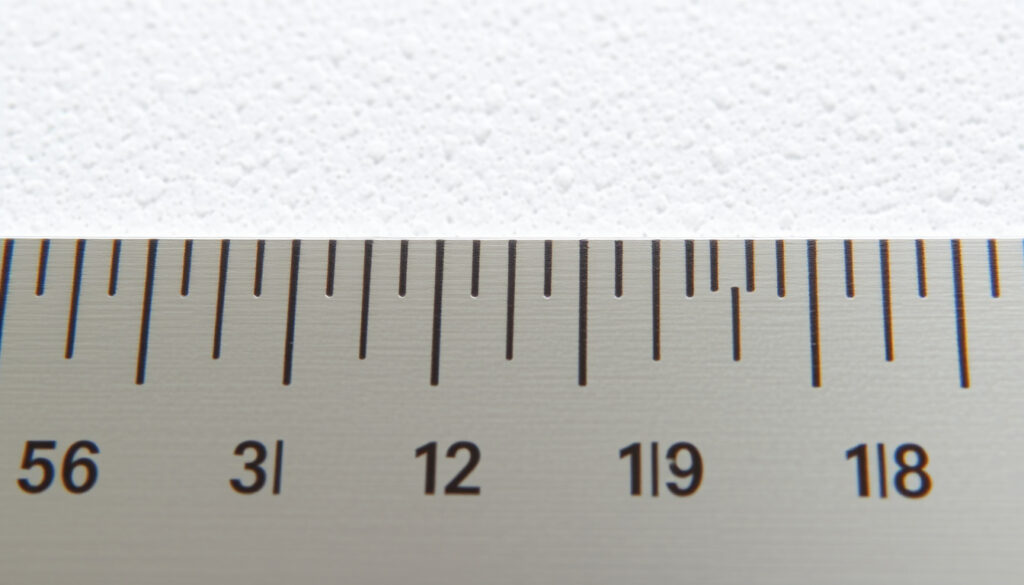
5/16 to mm: Exact Conversion Made Simple
Few things trip up a DIYer faster than staring at a metric wrench when your project calls for a fractional‑inch measurement. If you’ve ever needed to convert 5/16 inch to millimeters, you already know the number – but the real story is in the 0.0625 mm gap between 5/16 inch and the nearest whole‑millimeter size. This guide walks you through the exact conversion, compares it to common metric sizes, and explains when you can safely substitute and when you absolutely should not.
Exact conversion: 5/16 inch = 7.9375 mm ·
Closest metric size: 8 mm (difference 0.0625 mm) ·
Common confusion: 6 mm is 0.236 inches, not 5/16 ·
Formula: Multiply 5/16 by 25.4
Quick snapshot
- 5/16 inch = 7.9375 mm (Inch Calculator conversion tool)
- Formula: (5 ÷ 16) × 25.4 (Inch Calculator conversion tool)
- Industry‑specific tolerance for substitution – consult ISO 965 (metric screw thread standards) or ASME B18.2.1 for critical applications
- The 0.0625 mm difference is smaller than the thickness of a human hair (~0.1 mm) – Inch Calculator confirms the gap
- Check tolerance specs before swapping – MISUMI (industrial components supplier) advises using precise sizes for structural or hydraulic applications
| Decimal inch | 0.3125 |
| Millimeters | 7.9375 |
| Nearest metric standard | 8 mm (0.3150 inches) |
| Second nearest metric | 7 mm (0.2756 inches) |
What is 5/16 inch in millimeters?
The exact answer comes from the international inch‑to‑millimeter conversion factor: 1 inch = 25.4 mm, as defined by the National Institute of Standards and Technology (US measurement authority). Applying that to 5/16 inch gives you 7.9375 mm – an absolutely precise number that doesn’t round.
Conversion formula
The formula is simple: divide 5 by 16 to get the decimal inch value, then multiply by 25.4. So 5 ÷ 16 = 0.3125, and 0.3125 × 25.4 = 7.9375. The same method is used by every online SAE‑to‑metric calculator, including Inch Calculator (conversion tool) and Analytics‑Shop (conversion resource).
Step‑by‑step calculation
- Write the fraction: 5/16 inch
- Divide numerator by denominator: 5 ÷ 16 = 0.3125 (decimal inch)
- Multiply by 25.4: 0.3125 × 25.4 = 7.9375
- Result: 7.9375 mm
The implication: even a small rounding error can propagate in multi‑step calculations, so precise documentation matters.
Common fractional inch to mm conversion table
For quick reference, here are the exact millimeter equivalents for common fractional inches used in imperial designs.
| Fractional inch | Decimal inch | Exact mm |
|---|---|---|
| 1/8 | 0.1250 | 3.1750 |
| 3/16 | 0.1875 | 4.7625 |
| 1/4 | 0.2500 | 6.3500 |
| 5/16 | 0.3125 | 7.9375 |
| 3/8 | 0.3750 | 9.5250 |
| 7/16 | 0.4375 | 11.1125 |
| 1/2 | 0.5000 | 12.7000 |
| 9/16 | 0.5625 | 14.2875 |
| 5/8 | 0.6250 | 15.8750 |
| 11/16 | 0.6875 | 17.4625 |
| 3/4 | 0.7500 | 19.0500 |
The pattern: all conversions follow the 25.4 multiplier; the table lets you spot symmetries between imperial and metric series.
Is 5/16 the same as 8mm?
No – but the difference is tiny. 5/16 inch is 7.9375 mm, and 8 mm is 0.0625 mm larger, a gap of about 0.79% of 5/16 inch. Engineering charts from Bearing King (imperial‑to‑metric bearing chart) list 5/16 inch as 7.94 mm (rounded) and 8 mm as the next integer.
Exact difference
8.0000 mm minus 7.9375 mm = 0.0625 mm. That’s about 1/16 of a millimeter – often negligible for loose fits but critical in precision assemblies.
When substitution is acceptable
For non‑critical fasteners like furniture hardware or garden equipment, many tradespeople treat 5/16 and 8 mm as interchangeable because the 0.06 mm difference falls within common tolerance bands. However, MISUMI (industrial components supplier) warns that in precision applications – bearings, hydraulic fittings, aerospace fasteners – you must use the exact size called out in the specification.
The catch: the same 0.0625 mm gap that saves a hobbyist a trip to the hardware store can push an interference fit out of spec in a pressurized system.
“Specification tolerances in inch‑series fasteners are defined by ASME B18.2.1; the 0.0625 mm difference between 5/16 inch and 8 mm can push a thread fit out of its allowable limit.”
— ASME B18.2.1 (fastener dimensional standard)
“ISO 965 requires that metric thread fits respect pitch and class tolerances; a 0.0625 mm deviation can change a snug fit to a loose one.”
— ISO 965 (metric screw thread standards)
What metric size is closest to 5/16?
Among standard metric sizes, 8 mm is the nearest whole‑millimeter match. The second closest is 7 mm (0.2756 inches), but that’s 1.9375 mm smaller – a much larger gap. Inch Calculator confirms that 5/16 inch is closer to 8 mm than to 7.5 mm.
Nearest metric sizes: 8 mm and 6 mm
- 8 mm – 0.3150 inches, difference of 0.0025 inches (0.0625 mm)
- 7 mm – 0.2756 inches, difference of −0.0369 inches (−0.9375 mm)
- 6 mm – 0.2362 inches, difference of −0.0763 inches (−1.9375 mm)
Comparison chart
Three common fractional‑inch sizes and their nearest metric equivalents, one pattern:
| Fractional inch | Decimal inch | Exact mm | Closest metric | Gap from 5/16 |
|---|---|---|---|---|
| 5/16 | 0.3125 | 7.9375 | 8 mm (0.3150″) | — |
| 1/4 | 0.2500 | 6.3500 | 6 mm (0.2362″) | −1.5875 mm |
| 3/8 | 0.3750 | 9.5250 | 9.5 mm (0.3740″) | +1.5875 mm |
The pattern: 5/16 inch sits between 1/4 inch and 3/8 inch in fractional order, and its metric counterpart falls symmetrically between 6 mm and 9.5 mm, but not exactly centered. The implication: when building conversion tables, always list 5/16 inch alongside 8 mm as the primary match, but note the 0.0625 mm offset.
Can I use 5/16 instead of 8mm?
It depends on the application. The 0.0625 mm difference means 5/16 is slightly undersized for an 8 mm hole – the part will be loose. For clearance fits or non‑structural uses, this may be acceptable. For interference fits, torque‑sensitive joints, or pressurized systems, the mismatch can cause failure.
Pros of using 5/16 in place of 8 mm
- Often works for temporary repairs or prototyping
- Available almost everywhere in imperial hardware sets
- Cost savings if you already have a 5/16 wrench or bolt
Cons and risks
- Threads may strip under load if the screw is undersized
- Hydraulic or pneumatic seals will leak
- Not compliant with ISO 965 (metric screw thread standards) or ASME B18.2.1
A hobbyist building a shelf can get away with swapping 5/16 for 8 mm. A civil engineer specifying anchor bolts for a bridge cannot – the 0.06 mm gap could shift load distribution by several percent.
What this means: always assess the risk level; a loose fit in a bookcase is harmless, but a loose fastener in a braking system is not.
Is 10mm the same as 5/16?
No – 10 mm is significantly larger. 5/16 inch equals 0.3125 inches, while 10 mm is 0.3937 inches – a difference of 0.0812 inches (2.0625 mm). The two sizes are not interchangeable.
Comparison of 10 mm and 5/16
The table below shows how 10 mm compares to 5/16 and to the nearest fractional inch equivalent.
| Size | Inches | mm | Difference from 5/16 |
|---|---|---|---|
| 5/16 inch | 0.3125 | 7.9375 | — |
| 10 mm | 0.3937 | 10.0000 | +2.0625 mm |
| 13/32 inch | 0.40625 | 10.3188 | +2.3813 mm |
The catch: 10 mm is actually closer to 13/32 inch (0.406 inches) than to 5/16. MISUMI’s conversion table shows 13/32 equaling 10.32 mm, making it the proper fractional match for 10 mm.
The pattern: for any imperial‑to‑metric substitution, always check the nearest fractional inch match – not just the nearest whole mm – to avoid major mismatches.
Clarity: confirmed facts vs. what’s unknown
Confirmed facts
- 5/16 inch = 7.9375 mm exactly (Inch Calculator)
- 8 mm is the closest standard metric size (Bearing King conversion chart)
- Formula: 5 ÷ 16 × 25.4 (Analytics-Shop (conversion resource))
What’s unclear
- Exact tolerance allowances for substitution in specific industries (consult ASME B18.2.1 or ISO 965)
- How uniform the 0.0625 mm gap is across different fastener classes
- Why the decimal equivalent (0.3125) is often rounded in charts – the rounding convention varies by industry
For the average maker, close enough works. For an engineer designing a bridge or a medical device, the 0.06 mm gap can mean the difference between a safe joint and a catastrophic failure.
For a broader reference on converting fractional inches to millimeters, see our general inch to mm conversion guide.
Frequently asked questions
How thick is 6mm?
6 mm equals 0.2362 inches – about 15% smaller than 5/16 inch (0.3125 inches). It is not a close substitute for 5/16.
What is 1/4 inch in mm?
1/4 inch = 6.35 mm (exact: 0.25 × 25.4). It is smaller than 5/16 inch by 1.5875 mm.
What is 3/8 inch in mm?
3/8 inch = 9.525 mm. It is 1.5875 mm larger than 5/16 inch (7.9375 mm).
What is 1/2 inch in mm?
1/2 inch = 12.7 mm (0.5 × 25.4). Much larger than 5/16.
What is 3/4 inch in mm?
3/4 inch = 19.05 mm. Double 3/8 inch.
What is 5/8 inch in mm?
5/8 inch = 15.875 mm (0.625 × 25.4).
What is 3/16 inch in mm?
3/16 inch = 4.7625 mm. It is smaller than 5/16 by about 3.175 mm.
Related reading
- Best Video Editing Software: Free vs Paid Options Compared
- What Is an LLC? Limited Liability Company Guide (US & Ireland)
For anyone working with fasteners or measurements, the 0.0625 mm gap between 5/16 inch and 8 mm is a small number with big consequences. Make the substitution only after verifying your project’s tolerance requirements – or stick with the exact fit. Not every job needs micron‑level precision, but the one that does can’t afford a loose guess.
More related posts
 Why Do I Bruise So Easily? Deficiencies & When to Worry
 What Are the Ten Commandments? List in Order from Bible
 iPhone 16 Plus Colors – Full List and Details
 Watch Good Will Hunting: Streaming Guide for Ireland
 Who Won the Super Bowl 2025 – Eagles Defeat Chiefs 40-22
 Law & Order: SVU Season 28 Renewed? Full Streaming Guide & Cast
 When Is the NYC Mayoral Election? 2025 & 2029 Dates
 What Is a Topic Sentence? Definition, Examples & How to Write