What Is Apollo the God Of? Music, Prophecy & Healing
Apollo is far more than the sun god pop culture has reduced him to—and most portrayals miss the richer story. In the oldest myths, Apollo governed prophecy, music, and healing. The sun connection came later and remains contested among classicists. Here’s what the mythological record actually says.
Primary domains: music, prophecy, healing ·
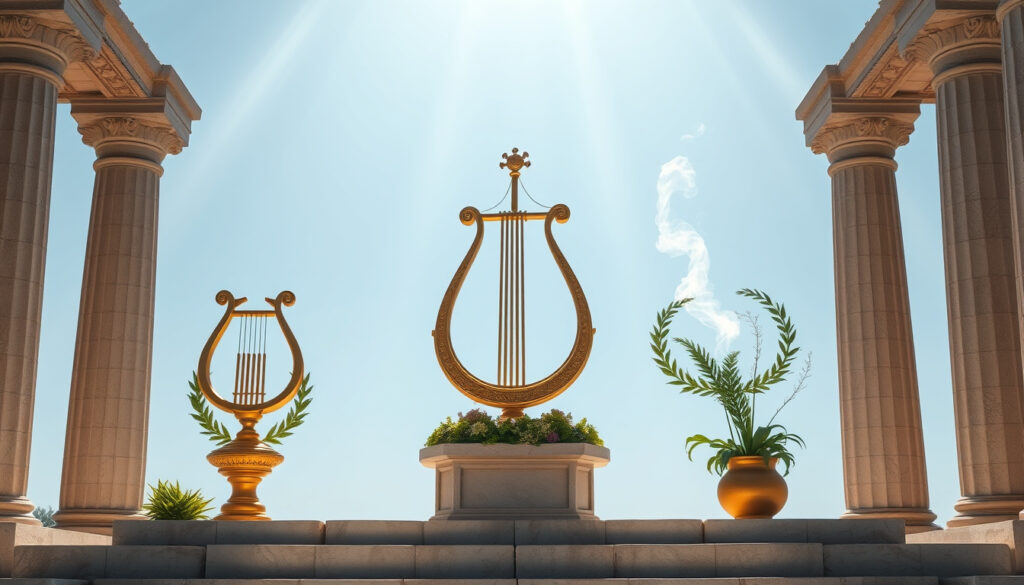
Key symbols: lyre, laurel wreath, bow ·
Roman equivalent: Apollo (epithet: Phoebus) ·
Oracle site: Delphi ·
Parentage: Zeus and Leto
Quick snapshot
- Apollo’s core domains span music, prophecy, and healing (Theoi.com)
- He is the twin brother of Artemis, son of Zeus and Leto (Wikipedia)
- The Oracle at Delphi channels his prophetic guidance through the Pythia priestess (Centre of Excellence)
- Apollo absorbed sun attributes from Helios over time, but the precise timing varies by source (Straight Dope Message Board)
- Claims about Apollo governing animals like wolves and bees have limited primary documentation (Straight Dope Message Board)
- Oldest myths distinguish Apollo (prophecy, music) from Helios (sun); sun absorption came later (Straight Dope Message Board)
- Apollo’s worship was imported to Rome in the 5th century BC (Wikipedia)
- Apollo’s sun associations solidified during the Hellenistic period, merging his image with Helios
- Modern popular culture continues to conflate the two, making Apollo’s true identity harder to recognize
Key attributes distinguish Apollo from other Olympian deities.
| Attribute | Value |
|---|---|
| Greek name | Apollon |
| Domains | Music, prophecy, healing, archery |
| Symbols | Lyre, raven, laurel |
| Sacred site | Delphi |
| Children | Asclepius, Orpheus (in some tales) |
What is Apollo the god for?
Apollo’s responsibilities span a remarkable range. He governed prophecy, music, poetry, dance, healing, plague, archery, and the oracle at Delphi (Theoi.com). According to Wikipedia, his functions included healing, prophecy, music, poetry, and archery, with Delphi as his primary sanctuary (Wikipedia). In the Iliad, Homer presents Apollo as both healer and bringer of plague, wielding his arrows to spread disease across the Greek camp.
Music and poetry
Apollo presides over music, songs, dance, and poetry as god of mousike—a term that in ancient Greek encompassed all artistic pursuits governed by the Muses (Wikipedia). His lyre, crafted by Hermes, became one of antiquity’s most powerful symbols. Poets and musicians invoked his blessing before performances, and he guided the Muses in their creative endeavors.
Prophecy and oracles
Apollo’s prophetic powers derive from Zeus himself, making him one of the most authoritative oracular figures in Greek religion (Theoi.com). The Pythia priestess at Delphi channeled his prophecies to seeking mortals, and supplicants traveled from across the Greek world to consult his oracle. His prophetic gifts positioned him as an intermediary between the divine and human realms.
Healing and plague
Apollo governs healing and disease in equal measure. He could cure illnesses through his divine power while also spreading plague—as demonstrated when his arrows brought suffering during the Trojan War (Wikipedia). This dual capacity for both wellness and affliction made him a deity to be both sought and appeased. His son Asclepius inherited and expanded his healing knowledge, becoming the god of medicine proper.
Apollo’s healing power came bundled with plague-bringing capability. Ancient Greeks understood this duality—asking Apollo for cure meant risking his displeasure equally.
Is Apollo the sun god or Helios?
This question exposes one of mythology’s most persistent confusions. Helios is the personification of the sun itself—he literally drives the sun chariot across the sky each day. Apollo, by contrast, is god of archery, music, and a suite of other traits (Timeless Myths). According to Wikipedia, Helios personifies the Sun in ancient Greek religion, the literal celestial body traversing the heavens (Wikipedia – Helios).
In the oldest myths, Helios was the sun god while Apollo governed prophecy, music, and plague. Over time, Apollo’s roles expanded to include the sun, gradually merging his image with Helios (Straight Dope Message Board). The two deities occupied fundamentally different roles: Helios represented the physical sun as a Titan, while Apollo embodied a multifaceted Olympian nature.
Distinction from Helios
The genealogical difference clarifies the distinction. Helios is a Titan, child of Hyperion and Theia. Apollo is an Olympian, child of Zeus and Leto (Timeless Myths). Their symbols differ accordingly: Helios associated with the sun and chariot, Apollo with python, bow, and arrows. Helios is Roman Sol; Apollo is Phoebus—a fundamentally different identity, not merely a naming variation.
Later sun associations
Apollo later became known as the new sun god while Helios represented the more ancient cosmic symbol of the physical sun itself (YouTube analysis). Apollo came to represent the spiritual light of knowledge, art, and prophecy, while Helios remained the literal sun personification. This evolution accelerated during the Hellenistic period, when Greek religious thinking increasingly synthesized earlier traditions.
Conflating Apollo with Helios erases their distinct mythological identities—one a Titan of the physical sun, the other an Olympian whose original domains centered on prophecy, healing, and the arts.
Is Apollo a god of beauty?
Beauty flows from Apollo’s artistic associations rather than constituting an independent domain. Greeks linked him to beauty through artistic depictions, poetic traditions, and his patronage of the Muses—the goddesses of creative inspiration. His physical depictions consistently portray him as youthful and handsome, setting aesthetic ideals that influenced Greek sculpture for centuries.
Associations with beauty
Apollo’s beauty connection operates through art and poetry rather than as a standalone power. Poets composed verses celebrating his physical perfection, and sculptors competed to capture his idealized form. His role as patron of the Muses—the nine goddesses governing music, poetry, dance, and knowledge—reinforced his association with aesthetic achievement.
Physical depictions
Greek art consistently rendered Apollo as a beautiful young man, establishing visual conventions that emphasized his physical perfection. This artistic tradition influenced how subsequent generations perceived the god, embedding beauty into his iconographic identity.
What is apollo the god of powers?
Apollo’s power set encompasses multiple domains. According to Theoi.com, he was the ancient Greek god of prophecy, oracles, music, poetry, archery, healing, plague, and protection of the young (Theoi.com). Ancient Origins notes that Apollo has powers related to prophecy, healing, and disease (Ancient Origins). His prophetic powers specifically source from Zeus, granting him divine authority over divination and oracular knowledge (Theoi.com).
Archery and protection
Apollo carries bow and arrows as divine weapons capable of both protection and destruction. The epithet Alexicacus identifies him as an averter of evil and danger (Wikipedia). His arrows brought plague in the Iliad, demonstrating his capacity to wield destruction against those who angered him or his divine family.
Animals and nature
Apollo’s dominion over nature extends to shepherds, wolves, and bees, though the extent of his animal authority remains partially documented in surviving myths. Claims about boxing or exclusive animal governance lack strong mythological support from primary sources.
Who was skinned alive by Apollo?
Apollo punished Marsyas, a satyr who challenged him to a musical contest. Marsyas lost, and Apollo responded with terrible violence—flaying him alive as punishment (Greek Mythology Tours). The myth illustrates Apollo’s capacity for extreme punishment when his divine authority was challenged or his artistic supremacy threatened.
Myth of Marsyas
Marsyas was a satyr renowned for his musical skill, particularly with the aulos (double flute). His confidence led him to challenge Apollo himself in a contest. The precise stakes and judgment criteria vary across retellings, but the outcome remained consistent: Apollo’s retribution exceeded any proportional response, stripping Marsyas alive. The myth has been interpreted as both a warning against hubris and a commentary on divine jealousy.
Other violent myths
Apollo killed Python at Delphi, slaughtered the children of Niobe as punishment for her insults to Leto, and accidentally killed Hyacinthus with a discus. These myths demonstrate Apollo’s capacity for destruction when his divine authority was challenged or his family insulted.
Apollo’s divine punishment tends to exceed perceived offenses. Marsyas challenged his musical authority and died. Niobe insulted Leto and her children perished. Excess, not justice, characterizes his retribution.
Confirmed facts
- Apollo governs music, prophecy, and healing domains consistently from Homer onward
- His parents are Zeus and Leto, twin of Artemis
- Delphi serves as his primary oracle, communicated through the Pythia priestess
- In the Iliad, Apollo wields plague arrows
- Apollo presided over music, dance, poetry, and song as god of mousike
- He functioned as an averter of evil, known as Alexicacus
- Helios represents the personified sun, son of Hyperion and Theia
- Apollo’s worship reached Rome by the 5th century BC
- He was known as Phoebus in Roman tradition
- Marsyas was flayed by Apollo
What’s unclear
- The extent of Apollo’s animal dominion—claims about specific creatures lack strong mythological sources
- Whether Apollo was recognized as a god of boxing—limited evidence supports this association
- The precise timeline of when Apollo absorbed solar attributes from Helios
- How much Phaethon’s parentage varies across different traditions and retellings
- The exact date when the Iliad was composed and first captured Apollo’s plague-bringing role
Quotes
In the oldest myths Helios is the sun and Apollo is the god of prophecy and music (and, arguably, plague).
— Mythology forum analysis on Greek sun deity distinctions
Apollo presides over music, songs, dance, poetry as god of mousike, which in ancient Greek encompassed all the arts fostered by the Muses.
— Wikipedia entry on Apollo (comprehensive mythological source)
The main difference between Helios and Apollo is that Helios is the personification of the sun while Apollo is the god of archery, music, and a few other traits.
— Timeless Myths analysis of Greek sun deities
Over time, Apollo became known as the new sun god, while Helios was seen as a more ancient cosmic symbol representing the physical sun itself.
— YouTube analysis of divine evolution
Summary
Apollo represents one of antiquity’s most intricate deities, his identity obscured by contemporary misconceptions that conflate him with the sun god Helios. Understanding Apollo demands recognizing what actually defines him: the god of prophecy, music, and healing whose oracle at Delphi shaped Greek civilization. The distinction carries weight—for anyone studying ancient religions, recognizing Apollo as originally distinct from Helios opens pathways to grasping how Greek mythology actually functioned. For readers encountering Apollo through modern portrayals, the mythological record clarifies that the sun association was a later development, not his original divine purpose.
Apollo’s mastery over music, prophecy, and healing sets him apart from Helios, as detailed domains overview reveals through myths like the Marsyas contest and Delphi oracle.
Frequently asked questions
What is Apollo known for?
Apollo is known as the god of music, poetry, prophecy, healing, archery, and oracle communication. He is the patron of Delphi, twin brother of Artemis, and son of Zeus and Leto.
What is apollo the god of animals?
Apollo is associated with shepherds, wolves, and bees, but claims about specific animals like goats or horses lack strong mythological documentation.
What is apollo the god of life?
Apollo’s healing domain connects to life—he could both cure diseases and bring plague. He was also invoked for protection during childbirth, though Artemis more directly governed childbirth.
Is Apollo the god of boxing?
Apollo is not primarily a god of boxing. He is the god of archery. Boxing is occasionally mentioned in his athletic contexts, but the evidence is limited.
Was Apollo LGBTQ?
Modern scholarship discusses Apollo’s relationships with both genders in Greek sources, including Hyacinthus and Cyparissus. However, modern sexual orientation categories don’t apply directly to ancient Greek deities.
Apollo’s Roman name?
In Roman mythology, Apollo retained the name Phoebus as an epithet. Unlike many gods, he lacked a completely distinct Roman name. Roman worship began in the 5th century BC.
Who did Helios fall in love with?
Helios loved the mortal Rhodus, and fathered three sons with her—Cameirus, Macareus, and Tenages—who built the city of Rhodes in her honor.
Are there any gods in direct conflict with Helios?
Myths don’t emphasize major conflicts between Helios and other gods. His divine interactions with Zeus and Poseidon appear in the Odyssey, but direct hostilities aren’t prominent in surviving myths.
Related reading
More related posts
 Somewhere Over the Rainbow Lyrics – Full Text and History
 5/16 to mm: Exact Conversion Made Simple
 Is Charlie Kirk Dead? Assassination Facts (2025)
 House Cleaners Near Me – Costs, Tips and Local Services
 What Time Do the Tigers Play Today? Schedule & TV Info
 I Can Do Bad All by Myself (2009) – Streaming, Cast, Meaning
 Dodgers vs Baltimore Orioles Match Player Stats: H2H
 India National Cricket Team vs South Africa National Cricket Team – Head-to-Head Records