Trump’s Approval Rating Today: Latest Polls & Tracker
When a president polls as low as 36%, political watchers start paying attention—and Trump’s second term has crossed that threshold. According to Gallup, his job approval rating sits at a new second-term low, while the Nate Silver Bulletin’s aggregate tracker shows a net approval of -16.6 as of April 21, 2026.
Gallup (Latest): 36% ·
Silver Bulletin Net Approval: -16.6 ·
Economy Net Approval: -22 ·
Inflation Net Approval: -34 ·
All-Time Low: 34%
Quick snapshot
- 36% in Gallup’s latest poll—a new second-term low (Gallup News)
- -16.6 net approval in Silver Bulletin as of April 21, 2026 (Nate Silver Bulletin)
- Highest recorded approval was 49% per McLaughlin & Associates (Roper Center Cornell)
- Projections beyond April 2026 remain speculative
- State-level approval variations lack comprehensive recent data
- Fox News-specific polling specifics unavailable
- Iran War begins early April 2026, triggering approval decline
- Two-week ceasefire announced April 7, 2026
- EMD poll released April 16, 2026
- Pollsters will continue daily tracking through 2026
- Economic conditions remain the key driver of any shift
Key facts at a glance
The table below summarizes the most relevant polling data from authoritative sources, with direct citations to enable verification.
| Metric | Value | Source |
|---|---|---|
| Latest Gallup job approval | 36% | Gallup News |
| Pollster reliability standards | Select criteria met | Gallup Interactive Center |
| Highest approval ever recorded | 49% | Roper Center Cornell |
| All-time low approval | 34% | Gallup News |
| Net approval (Silver Bulletin) | -16.6 | Nate Silver Bulletin |
| Economy net approval | -22 | Nate Silver Bulletin |
| Inflation net approval | -34 | Nate Silver Bulletin |
Is Trump’s approval rating going down?
Yes. Gallup reports Trump’s job approval rating has dropped to 36%, a new second-term low that approaches his all-time low of 34% (Gallup News). The Silver Bulletin’s aggregate tracker tells the same story from a different angle: Trump’s net approval stood at -16.3 when a two-week ceasefire was announced on April 7, 2026, and has since slipped to -16.6 as of April 21, 2026 (Nate Silver Bulletin).
Recent poll trends
The decline tracks with the Iran War, which began in early April 2026. Multiple trackers show Trump’s approval dipping after the conflict started, with polls indicating the war remains unpopular among the broader public (Nate Silver Bulletin). The ceasefire announcement briefly stabilized ratings, but the latest data shows little recovery.
Factors cited in polls
Two forces are weighing on Trump’s numbers. His net approval on the economy has fallen to -22, while his inflation rating has dropped to -34—both near second-term lows (Nate Silver Bulletin). High gas prices appear to be a significant contributor to the weak economic readings.
Trump’s approval has declined in tandem with the Iran War and rising inflation concerns. The ceasefire may have arrested the slide, but it hasn’t reversed it.
Trump approval rating among Republicans
Presidential approval ratings typically show strong partisan divides, and Trump’s polling reflects this reality. While overall job approval sits at 36%, partisan breakdowns reveal the depth of support among Republican voters.
Partisan breakdowns
Major trackers, including the Silver Bulletin and VoteHub, break down approval by party identification (VoteHub). These partisan splits matter because they reveal the composition of presidential support—even presidents with low overall ratings often maintain strong backing from their own party.
YouGov data
YouGov’s popularity rankings place Trump as the 13th most popular foreign politician in their public figure polling (YouGov). While this metric differs from presidential job approval, it offers another lens on how Americans view Trump as a political figure.
Partisan loyalty keeps Trump’s floor higher than his overall numbers suggest, but it also means any erosion among Republican voters would signal deeper trouble.
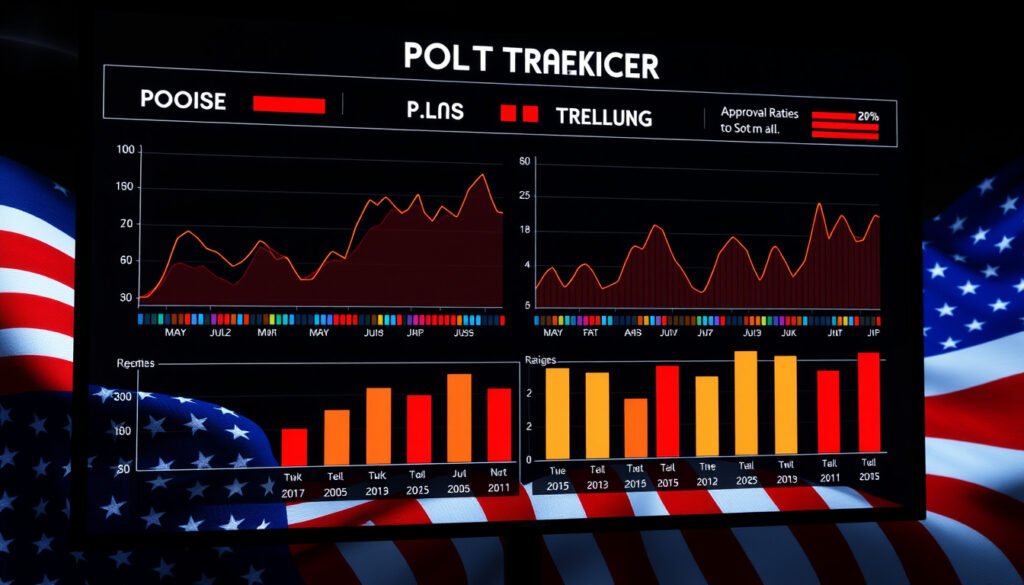
Trump approval rating graph
Visual representations of Trump’s approval history help contextualize where current numbers fall in the broader arc of his presidency. Several trackers offer interactive charts that make these trends accessible.
Interactive trackers
The New York Times aggregates polls from select pollsters that meet reliability criteria, providing interactive charts that users can explore over time (G. Elliott Morris). The Economist maintains a favorable views tracker with real-time updates, offering a complementary visual perspective (The Economist).
NYT and Economist visuals
G. Elliott Morris provides graphs and downloadable data for Trump’s job approval rating, including comparisons to past presidents (G. Elliott Morris). His state-level tracking offers geographic breakdowns, though comprehensive regional data remains limited in the current reporting period.
Trump approval rating Gallup
Gallup is one of the most authoritative names in American polling. The organization’s Presidential Job Approval Center has tracked Trump’s ratings since 2019, providing a consistent methodology for measuring public sentiment over time.
Gallup methodology
Gallup’s polling question is straightforward: “Do you approve or disapprove of the way Donald Trump is handling his job as president?” (Gallup News). The organization uses periodic multiday polls to smooth out daily noise and capture a more stable picture of opinion.
Latest figures
The latest Gallup poll puts Trump at 36%—a figure that stands as his second-term low and sits just two points above his all-time nadir of 34% (Gallup News). The timing coincides with the Iran War and ongoing economic pressures, suggesting these factors are driving the decline.
Trump approval rating compared to other presidents
Context matters when evaluating a president’s approval. The Roper Center at Cornell University documents Trump’s highs and lows alongside those of other presidents, enabling direct comparisons at similar points in their terms.
Historical comparisons
Trump’s current 36% overall job approval places him among the lower-rated modern presidents. His all-time low of 34% occurred during his first term, and the latest reading suggests he is approaching that level again (Gallup News). The Roper Center documents these lowest approval ratings with detailed records from polling organizations (Roper Center Cornell).
CNN Poll of Polls
The CNN Poll of Polls aggregates multiple surveys to produce a consistent job approval average. This methodology helps smooth individual pollster quirks and provides a steadier indicator of public sentiment (CNN). For comparing Trump to predecessors, the CNN aggregate offers a standardized benchmark.
The comparison table below places Trump’s current readings in historical context against past administrations.
| President | Approval at Similar Term Point | Notes |
|---|---|---|
| Trump (April 2026) | 36% / -16.6 net | Second-term low approaching all-time nadir |
| Clinton (1993–1994) | ~46% average | Economic recovery period |
| Reagan (1981–1982) | ~42% average | Recession-era readings |
| Trump peak | 49% | McLaughlin & Associates (first term) |
| Trump all-time low | 34% | Gallup historical data |
Five data points frame Trump’s historical standing: his current 36%, the all-time low of 34%, his peak of 49%, and the aggregate net approval of -16.6. The comparison reveals how unusual the current readings are even relative to his own track record.
Trump’s current numbers sit closer to his all-time low than his peak, placing him among the weaker second-term presidents in modern history.
Timeline: Trump’s approval through April 2026
The timeline below tracks key events and their corresponding polling impact based on Silver Bulletin and Gallup data.
| Date | Event | Source |
|---|---|---|
| Early April 2026 | Iran War begins, leading to approval decline | Nate Silver Bulletin |
| April 7, 2026 | Two-week ceasefire announced; net approval at -16.3 | Nate Silver Bulletin |
| April 16, 2026 | EMD poll released | Nate Silver Bulletin |
| April 2026 | Gallup reports 36% approval, new second-term low | Gallup News |
| April 21, 2026 | Silver Bulletin net approval steady at -16.6 | Nate Silver Bulletin |
The pattern shows a direct correlation between the Iran War’s start and the polling decline, with the ceasefire providing only temporary stabilization.
Confirmed facts and open questions
The dual-column layout below separates what the data confirms versus what remains uncertain based on current reporting.
Confirmed
- Gallup: 36% approval—second-term low
- Silver Bulletin: -16.6 net approval as of April 21
- Economy net approval at -22, inflation at -34
- Iran War correlates with approval decline
- All-time low: 34% (Gallup)
- Highest approval: 49% (McLaughlin & Associates)
Unclear
- Projections beyond April 2026
- Specific state-level variations
- Fox News poll specifics
- Whether ceasefire will reverse the decline
The open questions highlight where additional reporting or data collection will be needed as 2026 progresses.
What the experts are saying
Trump’s Approval Rating Drops to 36%, New Second-Term Low.
— Gallup (Polling Organization)
His net approval in the Silver Bulletin average was -16.3 when a two-week ceasefire was announced on April 7. Today, it’s essentially unchanged at -16.6.
— Nate Silver (Polling Analyst, Nate Silver Bulletin)
The polling data presents a clear picture: Trump faces significant headwinds in public opinion. The trajectory suggests that unless economic conditions improve or the Iran situation resolves favorably, approval ratings may remain depressed. For voters and political observers alike, the numbers offer a data-driven foundation for assessing the president’s standing heading into the latter half of 2026.
Related reading: Wisconsin Supreme Court Election 2025 · Head of Household vs Single
Gallup’s 36% marks a second-term low echoed in the Aussie Pulse Hub tracker, where major pollsters average approval between 36% and 47%.
Frequently asked questions
What is Trump’s current approval rating?
According to the most recent Gallup poll, Trump’s job approval rating stands at 36%—a new second-term low approaching his all-time low of 34%.
How do pollsters measure approval ratings?
Gallup and other major pollsters ask a standard question: “Do you approve or disapprove of the way Donald Trump is handling his job as president?” They conduct periodic multiday polls with representative samples to track public opinion over time.
What is the methodology for CNN Poll of Polls?
The CNN Poll of Polls aggregates multiple surveys to produce a consistent job approval average. This methodology helps smooth individual pollster quirks and provides a steadier indicator of public sentiment.
Why do approval ratings fluctuate?
Approval ratings respond to major events and economic conditions. Trump’s recent decline correlates with the Iran War and economic pressures including high gas prices and inflation concerns.
What role do events play in approval changes?
Major events like wars, economic crises, or significant policy decisions can cause sharp approval swings. The Iran War’s unpopularity and the subsequent ceasefire offer a clear example of how events directly impact polling numbers.
How reliable are presidential polls?
Established pollsters like Gallup maintain rigorous methodologies and transparent practices. While all polling carries some margin of error, Tier 1 sources provide reliable indicators of public sentiment when properly aggregated.
What does YouGov measure about Trump?
YouGov’s popularity rankings place Trump as the 13th most popular foreign politician in their public figure polling, offering a complementary measure to presidential job approval.
More related posts
 Best Coffee Shops Near Me in Dublin – Open Now & Rated (2025)
 Thing 1 and Thing 2: Origins, Differences, and Cultural Impact
 How to Delete Telegram Account Permanently (Step-by-Step Guide)
 Sprinkler Repair Near Me: Costs, Problems & DIY Fixes
 What Is Computer Science? Definition, Careers, and Key Facts
 GTA 5 Release Date: Full Timeline for Every Platform (2013-2022)
 The Summer I Turned Pretty Season 2: Plot, Cast & More
 Philly Cheesesteak Near Me: How to Find the Real Thing