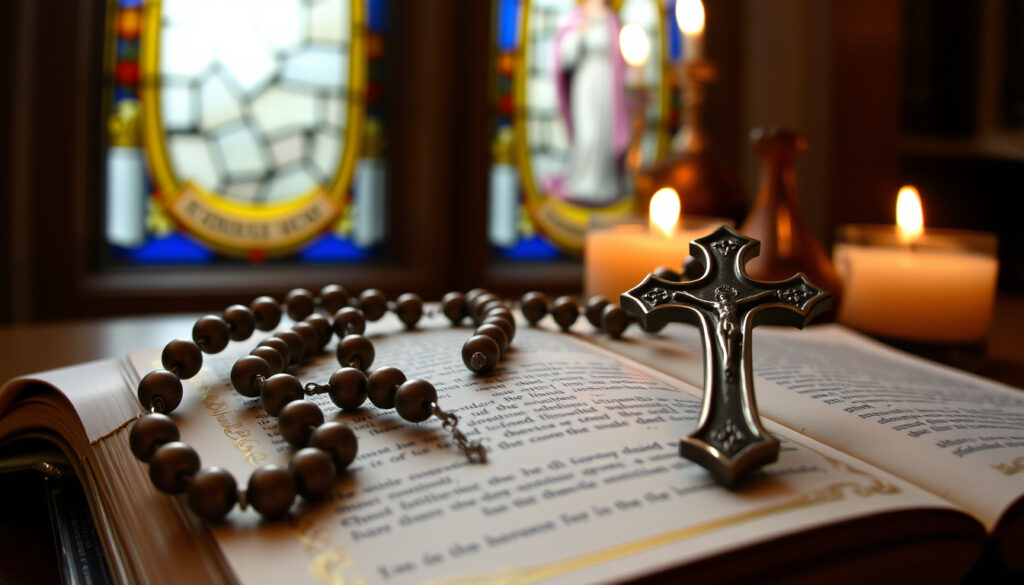
How to Pray the Rosary: A Beginner’s Guide with Mysteries
Learning the Rosary might seem daunting, but its beads mark a simple path through the Gospels. This guide walks through every step from the Sign of the Cross to the final prayer so you can start praying with confidence today.
Beads on a standard Rosary: 59 ·
Hail Marys recited in a full Rosary: 53 ·
Our Fathers recited: 6 ·
Sets of Mysteries: 4 ·
Total Mysteries: 20 ·
Promises attributed to the Rosary: 15 (according to tradition)
Quick snapshot
- The Rosary consists of four sets of five mysteries each (USCCB).
- Each decade includes one Our Father, ten Hail Marys, and one Glory Be (Rosary Center).
- The Luminous Mysteries were added by Pope John Paul II in 2002 (Vatican).
- The exact origin of sleeping with a rosary under the pillow is not documented in official Church teaching (New Advent).
- Whether memorization is “required” varies by personal comfort; no Church law mandates it (USCCB).
- The exact division of the Rosary into the current set of mysteries is not definitively documented in early Church records. (New Advent)
- The Rosary was established in the 15th century, attributed to St. Dominic (New Advent).
- Pope John Paul II added the Luminous Mysteries in 2002 (Vatican).
- Pick up your rosary and follow the step-by-step guide below.
- Choose the mysteries for today using the day-based schedule.
These numbers frame the scale of the Rosary: it is both ancient and deeply structured.
| Label | Value |
|---|---|
| Year the Rosary was established | 15th century (attributed to St. Dominic) |
| Total number of Hail Marys | 53 |
| Number of decades | 5 (one per mystery set) |
| Official feast day | October 7 (Our Lady of the Rosary) |
How do I pray a rosary step by step?
Working through a full Rosary for the first time is easier if you break it into five clear phases. The United States Conference of Catholic Bishops (USCCB) publishes the standard sequence, and the Rosary Center mirrors it with the same core structure.
- Start with the Sign of the Cross and Apostles’ Creed.
- Pray the Our Father and three Hail Marys.
- Announce the first mystery and pray the decade (one Our Father, ten Hail Marys, Glory Be).
- Repeat for five decades.
- End with the Hail Holy Queen and concluding prayer.
Starting with the Sign of the Cross and Apostles’ Creed
- Hold the crucifix and make the Sign of the Cross.
- Recite the Apostles’ Creed on the crucifix.
- This opening is the Rosary Center standard for beginning the Rosary.
Praying the Our Father and three Hail Marys
- On the first large bead, pray the Our Father.
- On the next three small beads, pray three Hail Marys — traditionally offered for an increase in faith, hope, and love (The Catholic Woodworker).
- On the next large bead, pray the Glory Be.
Announcing the first mystery and praying the decade
- Announce the mystery (for example, “The Annunciation” for the first Joyful Mystery).
- Pray one Our Father on the large bead.
- Pray ten Hail Marys on the ten small beads — meditating on the announced mystery as you go (USCCB).
- Finish with the Glory Be, and optionally the Fatima prayer (Rosary Center).
Completing the Rosary with the Hail Holy Queen and concluding prayer
- After all five decades, pray the Hail Holy Queen.
- Recite a concluding prayer (the Rosary Center recommends the prayer to St. Joseph).
- Finish with the Sign of the Cross.
Newcomers often worry they’ll lose their place. The beads themselves are a tactile guide — one large bead signals the Our Father; ten small beads mark the Hail Marys. You’re never actually lost.
The implication: the physical beads eliminate the need for memorization from the start.
What are the 5 mysteries of the Rosary in order and days?
The mysteries are the heart of the Rosary — they turn repetition into meditation. Each set contains five events from the lives of Jesus and Mary, rotated through the week. The Vatican publishes the official day assignments.
“The Rosary is a compendium of the Gospel.” — Pope John Paul II, Rosarium Virginis Mariae (2002)
The Joyful Mysteries (Monday & Saturday)
- The Annunciation
- The Visitation
- The Nativity
- The Presentation in the Temple
- Finding Jesus in the Temple
The Sorrowful Mysteries (Tuesday & Friday)
- The Agony in the Garden
- The Scourging at the Pillar
- The Crowning with Thorns
- The Carrying of the Cross
- The Crucifixion
The Glorious Mysteries (Wednesday & Sunday)
- The Resurrection
- The Ascension
- The Descent of the Holy Spirit
- The Assumption of Mary
- The Coronation of Mary
The Luminous Mysteries (Thursday)
- The Baptism of Jesus in the Jordan
- The Wedding at Cana
- The Proclamation of the Kingdom of God
- The Transfiguration
- The Institution of the Eucharist
The pattern: each week cycles through all four sets, so over seven days you meditate on 20 distinct moments from the Gospels. Pope John Paul II described these mysteries as “a compendium of the Gospel” in his 2002 apostolic letter Rosarium Virginis Mariae.
The catch: without the day schedule, you might miss the rhythm, but the Church provides clear assignments.
Do I have to memorize the Rosary?
Short answer: no. The Church does not require memorization before you begin. What matters is the disposition of the heart, not the perfection of the words.
Memorization is not required; a printed guide or app can be used
- Many Catholics learn by repetition over time (Rosary Center).
- A prayer card, booklet, or smartphone app works perfectly.
- No formal rule requires memorization.
Common prayers to memorize for fluency
- Sign of the Cross
- Our Father
- Hail Mary
- Glory Be
Tips for learning the prayers gradually
- Pray the Rosary with a guided audio or app like Hallow.
- Repeat the same set of mysteries until the prayers feel natural.
- Read the Hail Mary aloud five times before trying it from memory.
Don’t let memorization become a barrier. The Rosary is a conversation, not a recitation test. Your focus belongs on the mysteries, not the words.
The pattern: repetition builds fluency faster than forced memorization.
What not to do when praying the Rosary?
Common mistakes can pull you out of the meditative space. The Rosary Center and the USCCB both emphasize that the Rosary is a meditative prayer, not a race.
Avoid rushing or treating it as a mechanical recitation
- A full Rosary takes roughly 15–20 minutes.
- Pausing between Hail Marys to reflect aids meditation.
Do not use the rosary as a fashion accessory or toy
- Rosary beads are sacramentals in Catholic teaching and should be treated with reverence (New Advent).
- Wearing the rosary as a necklace is discouraged unless for devotion.
Avoid distractions and disrespectful handling of the beads
- Common mistakes: skipping the mysteries, letting the mind wander, or not pausing for meditation.
- Sitting quietly in a designated space helps maintain focus.
The implication: reverence transforms the Rosary from a list of words into a genuine conversation.
Why sleep with a rosary under your pillow?
The practice of placing a rosary under one’s pillow is widespread but not codified in official Church teaching. It’s a popular devotion rooted in the belief that the rosary, as a sacramental, offers spiritual protection.
Tradition of using the rosary as a protective object
- The rosary is considered a sacramental — a sacred object blessed by the Church.
- Many Catholics view it as a source of spiritual comfort during sleep.
Personal devotion and comfort
- Some people place it under their pillow for peaceful sleep or as a reminder to pray before bed.
- The practice appears in personal testimonies rather than official documents.
Distinction between superstition and pious practice
- The Catechism of the Catholic Church encourages sacramentals but warns against superstition.
- The rosary is an aid to prayer, not a magical object.
“The Rosary is a sacramental, an aid to prayer, not a magical charm.” — United States Conference of Catholic Bishops, USCCB
The catch: the line between devotion and superstition is intent; the Rosary remains a prayer tool.
How can I pray the Rosary every day?
Daily Rosary practice is a common Catholic devotion. The key is making it sustainable — and that often means starting small.
Setting a consistent time and place
- Many incorporate it into their morning or evening routine.
- A consistent space — a chair, a corner, a chapel — builds the habit.
Using a guided audio or app
- Apps like Hallow provide audio-guided Rosaries with Scripture readings.
- Podcasts and YouTube recordings offer free alternatives.
Praying one decade if a full Rosary seems too long
- One decade (one set of mysteries) takes about 5 minutes.
- The Rosary can be spread across the day — one decade in the morning, another at lunch.
The pattern: small steps sustain the habit longer than ambitious sprints.
For a more detailed rosary guide, see detailed rosary guide which breaks down each prayer and mystery.
Frequently asked questions
Can I pray the Rosary without beads?
Yes. You can count prayers on your fingers, use a finger rosary, or follow along with an app. The beads are a tool, not a requirement.
Is it okay to pray the Rosary in a group?
Absolutely. Group Rosaries are common in parishes, homes, and online prayer groups. The prayers are the same whether alone or together.
What is the difference between the Rosary and the Divine Mercy Chaplet?
The Divine Mercy Chaplet is a shorter devotion focused on mercy, prayed on rosary beads but with different prayers (the Eternal Father, the Fatima prayer, and the closing prayer). The Rosary is meditative; the Chaplet is intercessory.
How do I meditate on the mysteries?
Read the Gospel passage for that mystery before you begin. As you pray each Hail Mary, imagine the scene — the people, the setting, the emotions.
What are the indulgences associated with the Rosary?
The Church grants a partial indulgence for praying the Rosary in a church or family setting, and a plenary indulgence under specific conditions (sacramental confession, Eucharistic communion, and prayer for the Pope). Apostolic Penitentiary provides the details.
Can I listen to a Rosary podcast instead of reciting?
Listening attentively while following in your heart or on beads is a valid form of participation. The essence is meditation, not vocalization.
What is the history of the Rosary?
The Rosary’s roots trace to the 15th century and are traditionally attributed to St. Dominic. The structure evolved over centuries, with the Luminous Mysteries added by Pope John Paul II in 2002.
Do Protestants pray the Rosary?
Some Anglican and Lutheran traditions have adapted the Rosary or use prayer beads, though the full Catholic form — including the Hail Mary and the mysteries — is not universal in Protestant practice.
For new Catholics, the Rosary is less about perfection and more about presence. The beads mark a path through the Gospels, one decade at a time. The choice is simple: start today with one mystery, one decade, one prayer. Or put the beads under your pillow and mean it as a promise for tomorrow.
More related posts
 Brad Pitt F1 Movie Cast Guide 2025
 The Hunting Party (TV Series) Episodes – Complete Season 1 Guide
 Watch Good Will Hunting: Streaming Guide for Ireland
 How Long Is a Paragraph? A Guide to Paragraph Length in Writing
 Is Trump a Felon? Latest Verified Information (2025)
 Off the Shoulder Sweater: Styling Tips, Fit Guide & Brands
 Miami Dolphins vs Buffalo Bills Player Stats: 2025 Analysis
 I Can Do Bad All by Myself (2009) – Streaming, Cast, Meaning